
Updated: 29.05.2026
Introduction: AI-powered death from the sky
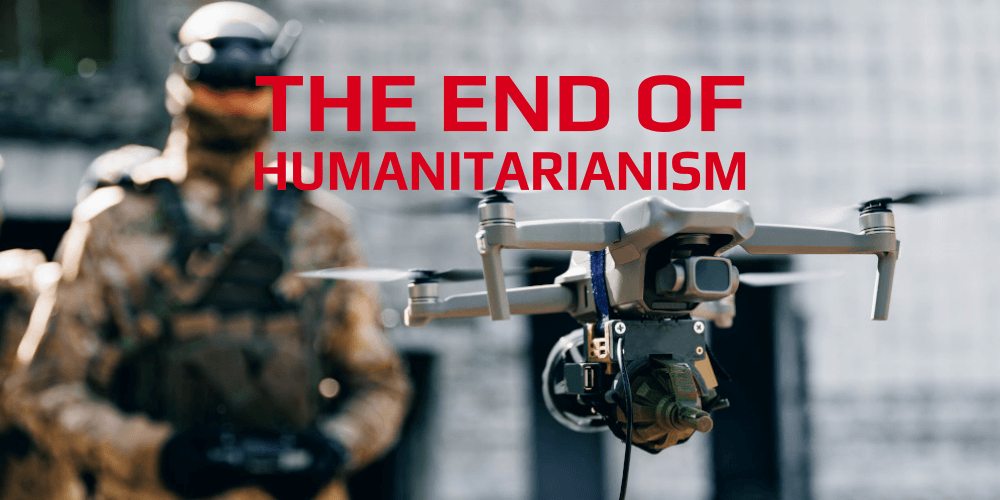
Since mid-2024, Russia has increasingly used drones to hunt civilians, humanitarian volunteers, medics, ambulances, buses and civilian cars in Ukraine’s frontline regions. This is not a theoretical future risk. Dozens of humanitarian workers in Ukraine have been injured or killed by Russian drones.
As humanitarian volunteers, we have been working in close proximity to the front line in the Kherson, Sumy, Zaporizhzhia and Kharkiv regions. Our evacuation vehicle was destroyed in Kherson by a Russian FPV drone armed with a high-explosive shell.
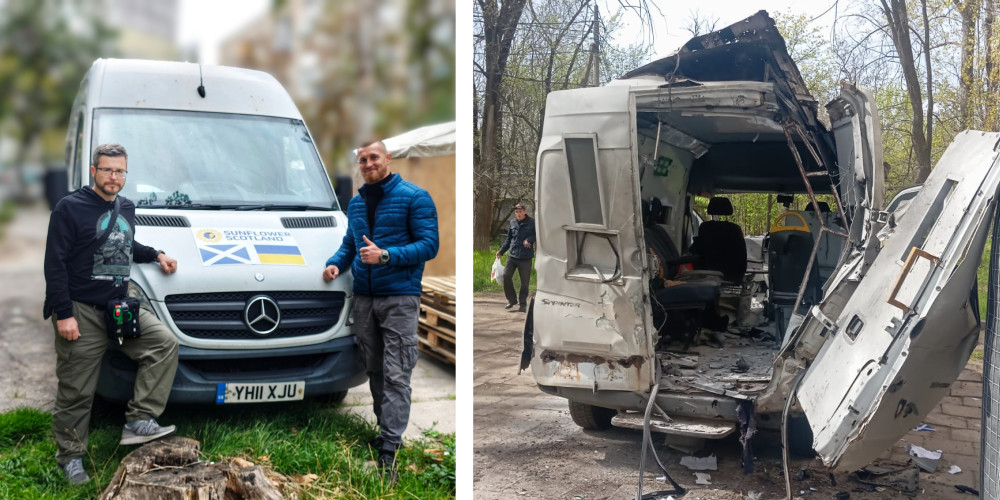
For humanitarian organisations, the world has already changed.
Until recently, the main risk was proximity to the front line. Volunteers learned to avoid the immediate range of mortars, artillery and small arms. If we stayed far enough from the military contact line, we could still bring food, water, medicine, generators, warm clothing and evacuation support to civilians.
That assumption is no longer safe.
Drones have expanded the danger zone. They can follow roads, identify vehicles, wait near likely evacuation routes, strike moving cars, drop explosives on buses, and attack crowds gathered for aid. Fibre-optic drones are making the situation even worse, because they are much harder to stop with conventional radio jamming.
The question for humanitarian organisations is painful and urgent: if drones can now reach deep into civilian areas, can war-zone humanitarian work continue at all?
1. Why frontline humanitarian work still matters
The obvious reaction is to withdraw from areas where drone warfare is active. No charity wants to send its staff or volunteers into a place where a £400 drone can destroy a vehicle and kill everyone inside.
But this is where humanitarian need is often greatest.
The people who remain near the front line are usually the least able to leave: older people, disabled people, families without money, people caring for relatives, and civilians who have nowhere safe to go. In winter, many struggle to access food, medicine, drinking water, electricity, heating and basic transport.

In some villages, people survive for months in damaged houses, basements and improvised shelters. Some areas have no shops, no pharmacies, no regular public transport and no safe medical access. When roads become dangerous, humanitarian volunteers may be the only people still willing to reach them.
This creates the moral dilemma at the centre of this article:
If humanitarian organisations withdraw, the most vulnerable people are left behind.
If they continue, volunteers and civilians will be exposed to drone attacks.
2. How drones changed the humanitarian danger zone
Before the large-scale use of drones, many humanitarian organisations treated the immediate danger zone as roughly the range of mortars and field artillery. In practice, volunteers tried to avoid getting closer than about 7–10 miles from the front.
In mid-2024 that changed.
Expanded danger area

FPV drones, bomber drones, retransmitters and loitering munitions have expanded the danger area. Vehicles can now be observed and attacked tens of miles behind the front line. A road that looked usable yesterday may become a kill zone today. A village that was difficult but reachable last year may now be unsafe for an ordinary humanitarian vehicle.
This matters because humanitarian work depends on movement. Volunteers must drive, unload, speak to civilians, deliver supplies, evacuate people and sometimes stop to help the wounded. Drones make all of those actions dangerous.
The first picture below shows the “old” 7-mile / 10 km danger zone (red) in the north-east Kharkiv region.

The second picture shows the danger area expanded to 25 miles / 40 km (grey). This is where drones can now target civilian and humanitarian vehicles. This new grey area covers hundreds of villages, with tens of thousands of people.

Unfortunately, this map is not a theory. It has been confirmed by recent events. In March 2026, Russian FPV drones reached the northern stretch of the ring road around Kharkiv (M-03) and started chasing vehicles. By April, several vehicles had reportedly been destroyed.
The road has been covered by anti-drone netting. However, drivers are advised to avoid it anyway, because Russian drones can still fly through small gaps under the nettig.
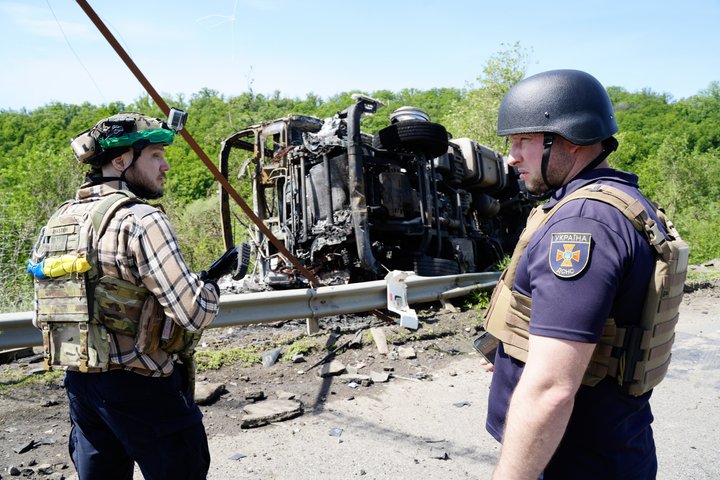
Old-style mass distribution puts people in danger
Drones also make humanitarian work dangerous for the civilians we are trying to help. A visible aid delivery can reveal where people are sheltering. A queue for bread, water or medicine can become a target. A volunteer vehicle parked near a basement or collection point can draw a drone strike (or a missile strike coordinated by a drone).
That is why mass distribution in frontline areas should no longer be used. Gathering people in one place creates a target, and charities need to stop doing this, including soup kitchens and bread distributions.
3. We are targets
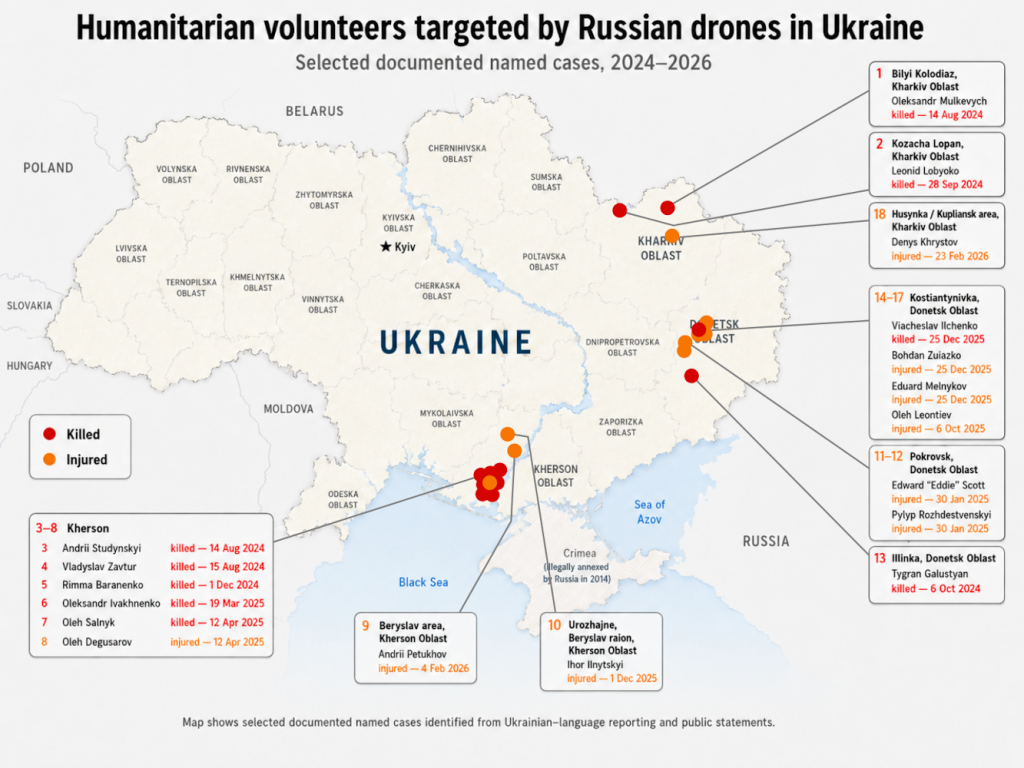
The following table lists selected documented named cases of humanitarian, evacuation, medical and animal-rescue volunteers killed or injured by Russian drones in Ukraine since 2022. It is not a complete list. Many attacks are reported without names, and some casualties are recorded only in local Telegram channels, police statements or regional administration updates.
| # | Name | Killed / injured | Location | Date | Source |
|---|---|---|---|---|---|
| 1 | Oleksandra “Mike” Mulkevych | Killed | Bilyi Kolodiaz, Kharkiv Oblast | 14 Aug 2024 | NV reported she was killed by an FPV drone strike on a Hospitallers vehicle. (NV) |
| 2 | Leonid Loboyko | Killed | Kozacha Lopan, Kharkiv Oblast | 28 Sep 2024 | Censor.NET reported he was killed when a drone hit a civilian car while he was delivering humanitarian aid. (Censor.net) |
| 3 | Andrii Studynskyi | Killed | Kherson | 14 Aug 2024 | Suspilne reported he was killed during a drone attack while distributing free water. (Суспільне | Новини) |
| 4 | Vladyslav Zavtur | Killed | Kherson | 15 Aug 2024 | Suspilne reported he died in hospital after being wounded in the same drone attack. (Суспільне | Новини) |
| 5 | Rimma Baranenko | Killed | Kherson | 1 Dec 2024 | Suspilne reported that the local volunteer died after a Russian attack on a bus; other reporting states explosives were dropped from a drone. (Суспільне | Новини) |
| 6 | Tygran Galustyan | Killed | Illinka, Kurakhove community, Donetsk Oblast | 6 Oct 2024 | 24 Kanal and Nakypilo reported he was killed during an evacuation mission when a Russian FPV drone hit the volunteers’ car. (24 Канал) |
| 7 | Edward “Eddie” Scott | Injured | Pokrovsk, Donetsk Oblast | 30 Jan 2025 | Suspilne reported the British volunteer was badly injured by a Russian drone while evacuating civilians; other reporting identifies him as Edward Scott. (Суспільне | Новини) |
| 8 | Pylyp Rozhdestvenskyi | Injured | Pokrovsk, Donetsk Oblast | 30 Jan 2025 | ZMINA and The Blackmore Vale reported that Pylyp received shrapnel wounds in the same drone strike. (ZMINA – Центр прав людини) |
| 9 | Oleh Salnyk | Killed | Kherson | 12 Apr 2025 | Censor.NET reported that Salnyk, a volunteer of the “Spravzhni” foundation, was killed by a Russian drone attack in Kherson. (Censor.net) |
| 10 | Oleh Degusarov | Injured | Kherson | 12 Apr 2025 | Protocol / Bukvy reported that Degusarov, co-founder of “Spravzhni”, was wounded in the same attack that killed Oleh Salnyk. (Protocol) |
| 11 | Oleh Leontiev | Injured | Kostiantynivka, Donetsk Oblast | 6 Oct 2025 | Suspilne reported a drone chased and damaged his evacuation car and that Leontiev was wounded while still evacuating civilians. (Суспільне | Новини) |
| 12 | Devon Masser | Injured | Near Lyman, Donetsk Oblast | 20 Nov 2025 | Suspilne reported an American volunteer was wounded when a Russian drone hit an evacuation vehicle; the New York Post identified him as Devon Masser. (Суспільне | Новини) |
| 13 | Ihor Ilnytskyi | Injured | Urozhayne, Beryslav raion, Kherson Oblast | 1 Dec 2025 | Ukrinform reported the ADRA Ukraine volunteer was seriously wounded by a drone while delivering food aid. (Ukrinform) |
| 14 | Viacheslav Ilchenko | Killed | Kostiantynivka, Donetsk Oblast | 25 Dec 2025 | Kramatorsk Rayon / ZMINA reported he was killed by a Russian FPV drone during an evacuation attempt. (Новини Краматорського району) |
| 15 | Bohdan Zuiakov | Injured | Kostiantynivka, Donetsk Oblast | 25 Dec 2025 | The same report states Zuiakov was wounded in the attack that killed Ilchenko. (Новини Краматорського району) |
| 16 | Eduard Melnykov | Injured | Kostiantynivka, Donetsk Oblast | 25 Dec 2025 | Suspilne reported that Eduard Melnykov was one of the wounded evacuation volunteers. (Суспільне | Новини) |
| 17 | Denys Khrystov | Injured | Husynka / Kupiansk area, Kharkiv Oblast | 23 Feb 2026 | Hromadske reported the volunteer was injured during an evacuation trip in the Kupiansk area. (hromadske) |
| 18 | Andrii Petukhov | Injured / survived drone attack | Kherson / Beryslav area | 2025–2026 | Suspilne and ZMINA documented repeated drone attacks on his evacuation work and the destruction of his evacuation vehicle. |
These people were not attacking anyone. They were evacuating civilians, delivering water, distributing bread, helping animals, driving medical or humanitarian vehicles, and supporting people who could not escape on their own.
Their names matter because drone warfare is often discussed as a technical subject: ranges, payloads, cameras, jamming, AI, batteries and fibre-optic cables. But the reality is human. A drone attack on a humanitarian car means a volunteer bleeding on the road, a family losing the only person who came to help, and civilians becoming even more isolated.
4. The drone system: eyes in the sky and precision killing
Drone warfare is not just about one flying machine. It is an ecosystem.
First, surveillance drones watch roads, villages, shelters and vehicles. Some are small quadcopters. Others are fixed-wing drones that can fly much farther and stay in the air for hours. They can observe movement, identify vehicles, and pass information to drone operators or artillery units.
Second, attack drones strike the target. These include bomber drones, FPV kamikaze drones and loitering munitions.
The table below gives examples of drone types used in the war. The figures are approximate and based on open-source specifications. In real battlefield conditions, range and payload change depending on batteries, weather, electronic warfare, retransmitters and modification.
| Type of drone | Example | Approximate range / operating radius | Explosive payload / warhead |
|---|---|---|---|
| Short-range surveillance quadcopter | DJI Mavic-type drones used by Russian units | Often several kilometres; newer commercial models can operate much farther in ideal conditions | Usually none as surveillance; can be modified to drop a small grenade or explosive |
| Fixed-wing reconnaissance drone | Orlan-10; ZALA Z-16 | Orlan-10: often cited around 120 km operational range; ZALA Z-16: about 50 km range | Normally none; carries cameras, thermal sensors, communications or relay equipment rather than explosives (Army Technology) |
| Bomber drone / grenade-drop drone | Modified commercial quadcopters; captured or copied heavy bomber drones | Small quadcopters: usually short range; heavy bombers often around several to tens of kilometres depending on payload | Small quadcopters: grenades or small charges; heavy bombers can carry much heavier payloads — some open sources cite up to around 15 kg or more for Baba Yaga-type drones (Combating Terrorism Center at West Point) |
| FPV kamikaze drone | Russian FPV drones, including fibre-optic FPV drones | Commonly around 5–15 km; longer ranges are possible with retransmitters, better batteries or fibre-optic systems | Often around 1–2 kg; larger FPV variants can carry heavier charges (CSIS) |
| Fibre-optic FPV drone | Russian fibre-optic FPV systems | Often discussed in the 10–25 km class; some newer systems claim much longer reach | Similar to FPV drones, but payload is reduced by the weight of the fibre spool; commonly anti-personnel or anti-vehicle charges |
| Loitering munition | ZALA Lancet | Lancet variants are generally reported as tens of kilometres; endurance often cited around 30–40 minutes | Lancet warheads are generally reported in the several-kilogram class; designed to destroy vehicles, artillery and air-defence assets (Army Technology) |
| Long-range one-way attack drone | Shahed-136 / Geran-2 | Hundreds to more than 1,000 km, depending on model and mission | Shahed-136 warhead commonly cited around 30–50 kg; some variants differ (Wikipedia) |
Surveillance drones
Short-range quadcopters, such as commercial Mavic-type drones, can carry high-resolution cameras and operate near the battle zone. They are used to watch movement, identify vehicles and guide attacks.
Longer-range winged drones can patrol much wider areas. Some carry day cameras, night cameras and thermal imaging equipment. They can remain airborne for hours and transmit images over long distances. This allows Russian forces to monitor roads and villages that used to be considered beyond the immediate danger zone.
One of the most widely used surveillance drones is Russia’s ZALA Z-16. With a maximum range of 75 km, it can observe the ground at altitudes from 200 metres to 5 km, staying in the air for up to 4 hours. This winged drone carries a 120-megapixel still camera for photos. It has a full HD video camera for day observations and a full HD thermal imaging camera for night vision.

Bomber drones
Bomber drones usually carry grenades, mortar rounds or other explosive charges. The operator positions the drone over a target and drops the munition from above. These drones can be used repeatedly and are especially dangerous in towns, near buses, at aid points or around people standing outside.
Heavy bomber drones are even more dangerous. They can carry larger munitions, operate at night and sometimes act as signal relays for other drones. This means that the threat is not only the drone directly above you; it may also be part of a wider system that extends the range of smaller attack drones.
FPV kamikaze drones
FPV means “first-person view”. The operator sees a live video feed from the drone and steers it directly into the target. The drone carries an explosive charge and is destroyed on impact.
FPV drones are cheap, accurate and terrifyingly effective. They can chase moving vehicles, enter streets, fly under cover, and strike a car with precision. For a humanitarian volunteer, the sound of a drone may now mean only seconds to react.
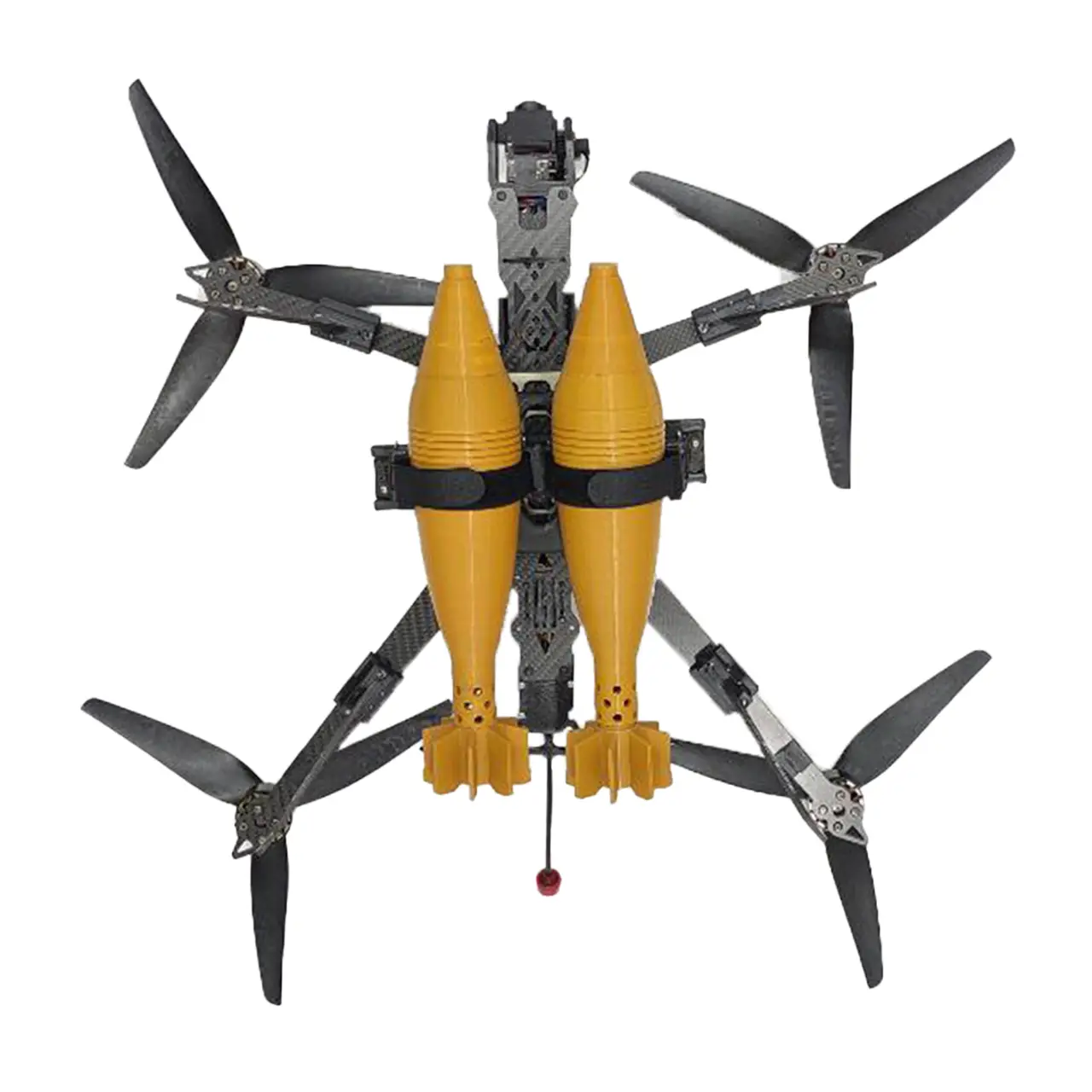
Here is an example of an FPV drone currently retailing for £400 (20,150 UAH). PD-DADCAT-10X4 can carry a 3 kg explosive charge for up to 15 km, or 3.5 kg as far as 10 km (credit: polydrone.com.ua).
Fibre-optic FPV drones make this even worse. Unlike ordinary radio-controlled drones, they are guided through a thin cable unspooling behind them. Such drones cannot be defeated by radio jamming.
In practice, a vehicle that once relied on electronic countermeasures may no longer be protected.
As of May 2026, some commercially available fibre-optic FPV drones claim ranges of up to 30 km.
Loitering munitions and longer-range systems
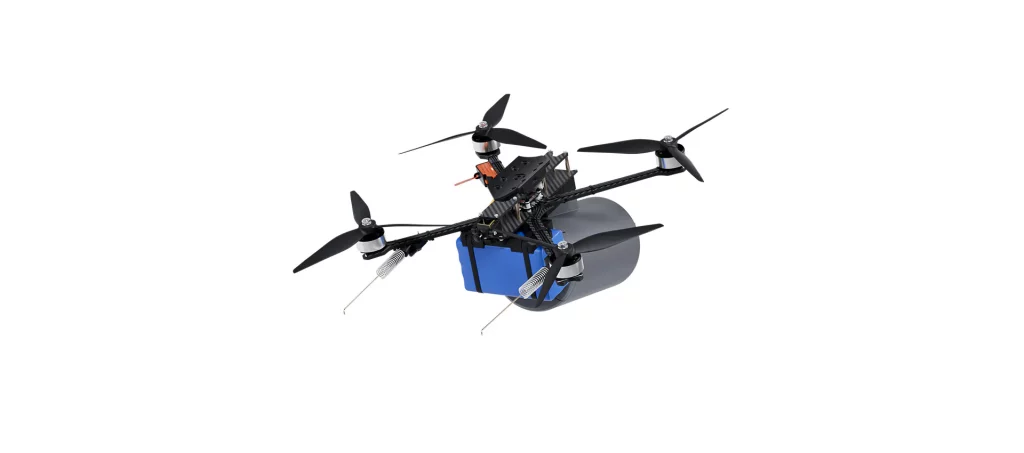
Loitering munitions, such as the Russian Lancet, sit between a drone and a missile. They can search for a target, wait, and then dive into it. Their range and warhead make them a serious threat to vehicles, artillery and infrastructure.

Long-range one-way attack drones, such as the Shahed-136 / Geran-2, are a different category. They are not normally used to chase an individual humanitarian vehicle. Instead, they are used to strike cities, power stations, warehouses and infrastructure deep inside Ukraine. But they are part of the same strategic shift: cheap unmanned systems are allowing Russia to create constant danger across a much wider area.
5. The harrowing cheapness of death
The most disturbing feature of drone warfare is its cost.
A simple FPV drone may cost only a few hundred dollars. Yet it can destroy a humanitarian vehicle worth thousands, disable an ambulance, kill a driver, or stop an evacuation mission. The economic imbalance is brutal: a cheap drone can remove an expensive vehicle, experienced volunteers and a vital lifeline for civilians.
The table below shows approximate open-source cost ranges. These figures should be treated carefully. Prices vary by supplier, sanctions, battlefield shortages, military procurement, electronics, camera quality, battery type and whether the figure is for one drone or a full system with control station, launcher and spare parts.
| Type of drone | Example / name | Approximate open-source cost |
|---|---|---|
| Commercial surveillance quadcopter | DJI Mavic 3 / Mavic-type drone | Roughly $2,000–$3,000 for many commercial models or kits; prices vary by market and accessories |
| Basic FPV kamikaze drone | Standard racing-drone-style FPV | Often reported around $200–$1,000; Ukrainian reporting commonly describes simple FPVs around $300–$500 (CSIS) |
| Heavy FPV / heavy bomber drone | Baba Yaga / Vampire-type systems | Open-source figures vary widely; battlefield reporting commonly places heavy reusable bomber drones in the several-thousand to tens-of-thousands of dollars range, depending on payload and sensors |
| Fixed-wing reconnaissance drone | Orlan-10 | RUSI estimated Orlan-10 production cost at roughly $87,000–$120,000; older reporting cited about $150,000 for a system including two drones and ground equipment (RUSI) |
| Fixed-wing reconnaissance system | Shark UAV system | Public Ukrainian fundraising figures have cited about $325,000 for a system, typically including multiple UAVs and ground equipment, not just one airframe (Wikipedia) |
| Loitering munition | ZALA Lancet | Often reported around $35,000–$37,000 per munition (Reuters) |
| Long-range one-way attack drone | Shahed-136 / Geran-2 | Public estimates vary widely: often $20,000–$50,000, while leaked contract figures and later reporting suggest much higher prices in some procurement contexts (Wikipedia) |
In this example, the 10-inch FPV drone MARK 4 is offered by Ukrarmor for £570. It can lift up to 3 kg of explosive charge. For £400 you can buy the 7-inch version FPV MARK 4, which can carry a 2 kg payload. Both offer a range of 10 miles (17 km).

This is the new arithmetic of drone war.
A £300–£500 FPV drone can destroy a £10,000–£30,000 humanitarian vehicle. A drone costing less than a family car can kill a volunteer who took years to train and who may be the only person still willing to reach a village. A cheap loitering munition can destroy a generator, ambulance, aid warehouse or evacuation vehicle.
For humanitarian organisations, this creates a serious operational problem. Armoured vehicles, electronic countermeasures, trained drivers, helmets, body armour and trauma kits are expensive. Small charities rarely have the budget of military units or large international agencies.
The result is a dangerous gap. The people taking the highest risks often have the least protection.
This is why drone warfare is not just a military issue. It is now a humanitarian access issue. It decides who can be reached, who can be evacuated, who receives medicine, and who is left alone in villages where even the road has become a target.
6. Artificial intelligence and the next stage of danger
The next stage is artificial intelligence.
AI is already being introduced into drone systems for target recognition, tracking and assisted navigation. This matters because human control is one of the few remaining limits on drone attacks. If drones become better at identifying vehicles, locking onto targets and continuing the attack after losing radio contact, the danger to civilians and volunteers will increase further.
Humanitarian vehicles are especially vulnerable because they are predictable. They use roads. They return to the same villages. They stop near shelters. They may be marked with humanitarian signs. In a normal war, those signs should protect them. In this war, they may make them easier to recognise.
This is why humanitarian organisations must treat drone warfare as a permanent change, not a temporary battlefield fashion.
Russia’s ZALA Z-16 claims to have an AI system installed onboard, which can process video in real time and identify targets. This information is then passed to the operator, who can decide what to do next. We can assume that Russia is actively developing and testing AI software as we speak, and all its mainstream drones will soon have it.
Ukraine’s Vyriy Drone claimed that it was about to start mass production of FPV drones with AI. It has two functions: first, identifying a target and keeping it locked; second, guiding the drone to the target like an autopilot. This allows the drone to hit its target even when it loses communication with its human operator.
We can assume that all leading drone manufacturers are actively moving towards AI. At the time of writing, human operators are still in control. But it may well be that within months, artificial intelligence may be deciding what vehicles gets tracked and attacked.
7. Should humanitarians continue in frontline areas?
This is the hardest question.
We need to stop and think. The overview of the drone technology clearly shows that (a) humanitarian vehicles are monitored 24/7; (b) humanitarian workers can be mistaken for military personnel; (c) we can be hit tens of miles behind the front line.
The humanitarian situation in the frontline areas is becoming even more difficult. The people who remain are the poorest, oldest, sickest and most isolated. They did not choose to become targets. They do not have the money, health or family support to move to safer cities. Some are caring for disabled relatives. Some are too frightened to leave. Some simply have nowhere to go.
If humanitarian organisations leave completely, these people may be abandoned. Unfortunately, charities cannot protect their employees and volunteers from drones. In this new world, some aid deliveries may carry risks that are no longer acceptable. Charities need to assess carefully and balance the risk against the likely humanitarian outcome.
The most viable strategy is to stop low-impact aid and concentrate on missions with high humanitarian impact.
For example, in Ukraine the risk of starvation is not high. However, local hospitals may be lacking certain medical supplies or mobility aids. By providing high-value, long-lasting humanitarian impact, charities can justify higher risk.
Each type of humanitarian mission should be reviewed very carefully on its merits.
8. Operational challenges for frontline humanitarian work
Drone warfare creates several practical challenges for humanitarian organisations.
Volunteers deliberately targeted
The documented cases above show that humanitarian, evacuation and medical volunteers are being hit while carrying out civilian tasks. These are not isolated battlefield accidents. The pattern is visible across Kherson, Kharkiv and Donetsk regions.
Aid delivery can expose civilians
A visible aid point can reveal where people are sheltering. A crowd waiting for bread or water can become a target. Humanitarian organisations must stop thinking only about how to deliver aid efficiently. They must also think about whether the delivery method exposes civilians to greater danger.
Training is often inadequate
Many volunteers are brave but not trained for drone warfare. They may not know how to recognise drone sounds, how to behave if watched, how to move under drone threat, or how to respond to blast and shrapnel injuries.
This is no longer optional. Frontline humanitarian work now requires drone-awareness training and trauma first-aid training.
Protection is expensive
Military vehicles may use armour, electronic warfare systems and intelligence support. Humanitarian vehicles usually do not. Most charities cannot afford proper protection, and many volunteers drive ordinary cars or vans.
This creates a serious ethical and operational problem. If a charity sends people into a drone danger zone, it must ask whether they are properly equipped for that risk.
9. Sunflower Scotland’s response: adapting our protocols
At Sunflower Scotland, we have changed our procedures to reflect the new risks created by drone warfare.
We do not present these points as advice to others. Every organisation is responsible for its own risk assessment, training and legal duties. These are simply examples of the changes we are making in our own work.
Our current approach includes:
- avoiding camouflage, military-style clothing or army-green vehicles;
- keeping humanitarian vehicles clearly civilian in appearance;
- avoiding large aid queues or mass gatherings in frontline areas;
- unloading quickly and leaving quickly;
- reducing time spent stationary in exposed places;
- improving first-aid readiness for blast and shrapnel injuries;
- carrying appropriate trauma kits;
- improving planning before entering high-risk areas;
- reviewing each mission based on the latest local information;
- treating drone risk as a core part of humanitarian risk assessment, not an afterthought.
The old model of aid delivery — arrive, gather people, unload, distribute, talk, photograph, leave — is no longer safe in many frontline areas.
Conclusion: humanitarianism has entered the drone-war age
Drone warfare has created a new reality for humanitarian work in Ukraine.
The danger zone is wider. Civilian roads are watched. Ordinary cars can be hunted. Volunteers can be followed and killed far from the trenches. A drone costing a few hundred pounds can destroy a vehicle, stop an evacuation and end a life.
But the need has not disappeared. In fact, the need is often greatest in exactly the places where the danger is highest.
That is the tragedy of frontline humanitarian work in Ukraine today. The people who most need help are often the hardest and most dangerous to reach.
We do not believe the answer is to abandon them. But we also do not believe that courage is enough. Humanitarian organisations must adapt to drone warfare with discipline, training, better equipment and stricter procedures.
This is not a one-time adjustment. It is an ongoing process. Drone technology is changing quickly, and humanitarian practice must change with it.
The purpose remains the same: to help people in the worst circumstances of their lives. But the way we do it has changed forever.
0 Comments for “Drones and AI: the end of war-zone humanitarianism?”