

The purpose of this article is to explain the actual dangers of drones to humanitarian aid workers, medics and first responders, and to propose practical solutions. It is based on my first-hand experience of running an NGO and helping Ukraine since 2022.
The Russian army is destroying Ukrainian ambulances and marked humanitarian vehicles with precision FPV drones. The danger area is expanding: drones hit targets 30 km from the front. Humanitarian and first-responder vehicles are unprotected: most have no armour or anti-drone jammers. Our analysis of humanitarian casualties in Ukraine shows that in 2026 two thirds were victims of drones. This is a significant change from previous wars, where most aid workers were injured by conventional weapons or land mines.
First-hand experience
As the head of Sunflower Scotland, I have been helping to save lives near the front since 2022. At the time of writing, we are supporting 12 hospitals and a number of field medical teams.
During 2022-2023, FPV drones were the problem of soldiers in the trenches. From 2024, Russia started hunting aid workers in Ukraine: Aid Worker Security Database (AWSD) shows first confirmed injuries and deaths by drones. In 2025, my team and I were supporting three hospitals in Kherson. In 2026, we can barely reach two: the third, Kherson City Clinical Hospital, is now deep in the drone kill-zone.
Drones are becoming more dangerous by the minute. In the summer of 2026, I was helping Ukrainian paramedics with medical evacuations at the front. My job was to watch out for drones in the air, while two paramedics were treating the wounded in the ambulance.
Studying how drones affect humanitarian missions is critically important. Today, this mostly affects Ukraine. But in the near future, drones will be a major challenge for humanitarians in conflict zones all around the world.
Drones, not tanks, are already the number one weapon
First-person view (FPV) drones are small and inexpensive flying machines, typically costing less than $1000. They can strike and destroy targets with incredible precision, at a distance of up to 30-40 km. They are cheap and available in huge quantities. In 2025 Russia produced about 4 million FPV drones, and the forecast for 2026 is 7.3 million (Kyiv Post, 8 May 2026).
In January 2026, President Zelenskii said that more than 80% of targets are currently destroyed by drones (President.gov.ua, 26 January 2026). He said that Ukraine would produce 10 million drones in 2026, while independent sources state between 7 and 10 million (Forbes, 26 April 2026).
These are practical conclusions from my work in Ukraine, which can help any humanitarian organisation to prepare and protect their staff.
1. Ambulances and marked humanitarian vehicles are destroyed with impunity
The Russians have been targeting Ukrainian ambulances and humanitarian vehicles with precision FPV drones.
Ukrainian paramedics claim that Russia specifically chooses ambulances. We have seen local news and witnessed many destroyed ambulances while working with paramedics. We can confirm that ambulance signage does not offer any protection.
There may be a number of explanations. The European road ambulances donated to Ukraine have bright yellow, green and red colours. They make these vehicles easier to spot. They attract the attention of the enemy’s drone operators looking for a kill. It is also possible that AI targeting algorithms find it easier to aim at vehicles with bright patterns.
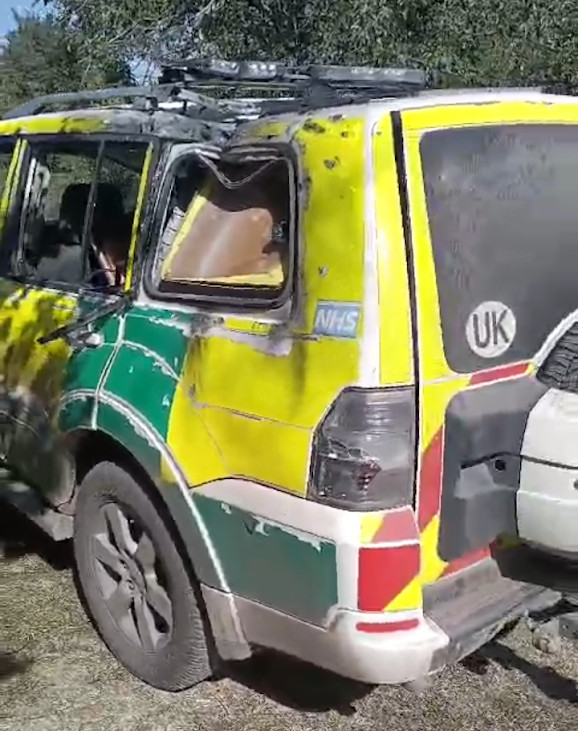

Russian drone operators are destroying ambulances with impunity. While some cases do get coverage in the news, by mid-2026 they drowned in the massive flood of war crimes committed by Russia: the brutal destruction of blocks of flats with residents inside, children’s hospitals, shopping malls.
Effect on humanitarian work: medics and humanitarian workers should stop using bright coloured ambulances. Marked vehicles put people at risk.
2. Drones hit targets 30 km from the front, and the hit zone is expanding
While helping paramedics at the Zaporizhzhia front, we eye-witnessed Russia’s drones covering a distance of 20-25 km. I was watching for drones using “Chuika” – a hand-held drone detector. When we saw or heard a drone, everyone quickly took cover.
I saw petrol stations destroyed by FPV drones in Kharkiv city centre, 30 km behind the front line.
During 2025-2026, the rapid increase of the range was driven by technological advancements. Batteries can work for longer. Navigation chips and AI can guide the drone automatically, even if it loses connection with the operator. In 2026, AI is able to select a target from a pre-defined library. “Mesh networks” keep internet access over long distances.
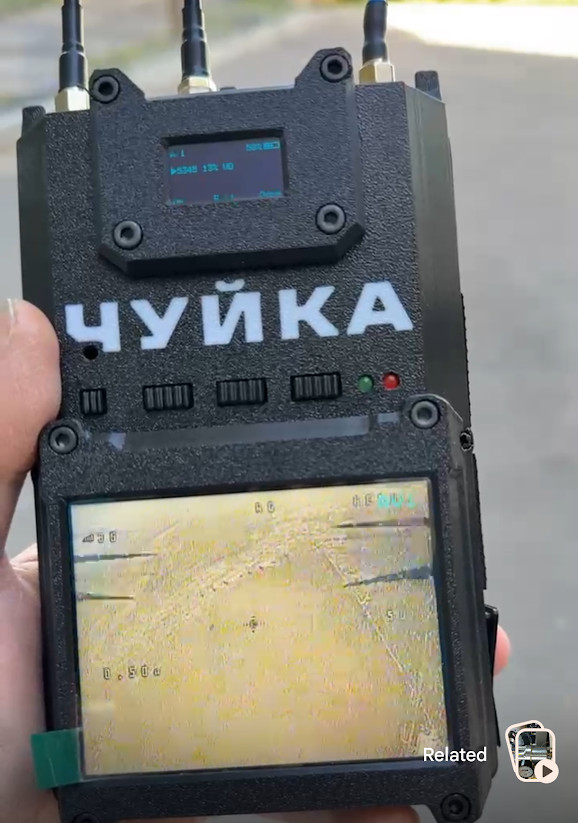
We expect that FPV drones will be operating at 50-60 km in the near future.
Effect on humanitarian work: the kill zone has expanded from 10 km (2024) to 30 km (2026). Hundreds of thousands of people living in these areas became targets. They risk their lives when taking public transport, going to work, to a hospital, or to a marketplace to buy food. Simply walking outside may be suicidal.
Humanitarian workers providing essential services face the most extreme risk. Their humanitarian vehicles are targeted (see Section 1). There is no viable solution, because one cannot evacuate hundreds of thousands of people.
3. Humanitarian vehicles are unprotected for drone warfare
FPV drones fly at speeds of up to 100 mph. They can hit and destroy ambulances and humanitarian vehicles when they are either stationary or driving, even at high speed.
The vast majority of humanitarian cars and vans aren’t armoured. They don’t have drone detection systems or anti-drone jammers. In short, they are completely unprepared.
Armoured vehicles cost 3-5 times more than standard, non-armoured versions. The armour itself has a substantial price tag. Because of the extra weight, vans and cars need more powerful engines and suspension.
Drone detectors (Chuika, Dziga or similar) are not very expensive, and a number of Ukrainian producers offer them for $1,000 – $1,500 apiece.
However, anti-drone jammers are much more costly. Even basic systems cost around $10,000 per vehicle. They generate a “noise dome” over a vehicle in a range of frequencies, typically from 300 to over 1,000 MHz. Jammers can defend against drones with radio control. Unfortunately, they don’t protect from drones controlled via fibre-optic cable.

But most importantly, jammers are supposed to be used only by the military. Such defences can disrupt both enemy and friendly drones, and there are quiet periods when they should not be operational.
This means that the use of anti-drone defences by humanitarian workers need to be coordinated with the military. This is a tough task which currently relies on goodwill and human contact.
Going forward, there will be a need for protocols between humanitarians and the military on how and for how long the aid workers can use radio jammers and HF radios in danger zones.
Effect on humanitarian work: humanitarian organisations need to protect their staff by protecting their vehicles. This is a tough and expensive task, which involves armouring the vehicles, installing drone detectors and jammers.
4. Humanitarian workers are targets for drones
We analysed the Aid Worker Security Database records for Ukraine, and studied local Ukrainian sources for every attack in 2026.
Of the 33 humanitarian workers recorded as killed or wounded in our analysis for January–17 September 2026, 67% were victims of drone attacks.
The death of an aid worker from the Banderol missile (AWSD incident 6197) illustrates how these categories are becoming blurred. Banderol has been described as a hybrid of a drone, an aerial bomb and a missile. For this analysis, we classify it as a cruise missile.
| Recorded attack type | Killed | Wounded | Total | % | Sources |
|---|---|---|---|---|---|
| Drones | 4 | 18 | 22 | 67% | Killed: AWSD 5830, 6243 Injured: AWSD 5571, 5675, 5818, 5835, 5843, 5853, 5893 (Pravda.com.ua), 5897, 6011, 6227, 6251 |
| Missile and glide bomb strikes | 6 | 5 | 11 | 33% | Killed: AWSD 5858 (Dnipto.tv), 6008 (Grivna.ua), 6197, 6208 (Pravda.com.ua) Injured: AWSD 5836, 6008, 6208 (Zmina, Pravda.com.ua) |
Sources: Aid Worker Security Database’s Ukraine incident records, January – 17 September 2026, AWSD, Pravda.com.ua, Grivna.ua, Dnipto.tv
It is a remarkable distinction from previous wars, where humanitarians were harmed by conventional weapons or land mines. It is obvious that drones are already replacing them.
In terms of geography, we mapped selected cases where humanitarian workers were injured or killed by drones during 2024-2026. We analysed public media reports and mapped where attacks took place (see “Appendix: Humanitarian victims of drone attacks in Ukraine, 2024-2026” at the end of the article).
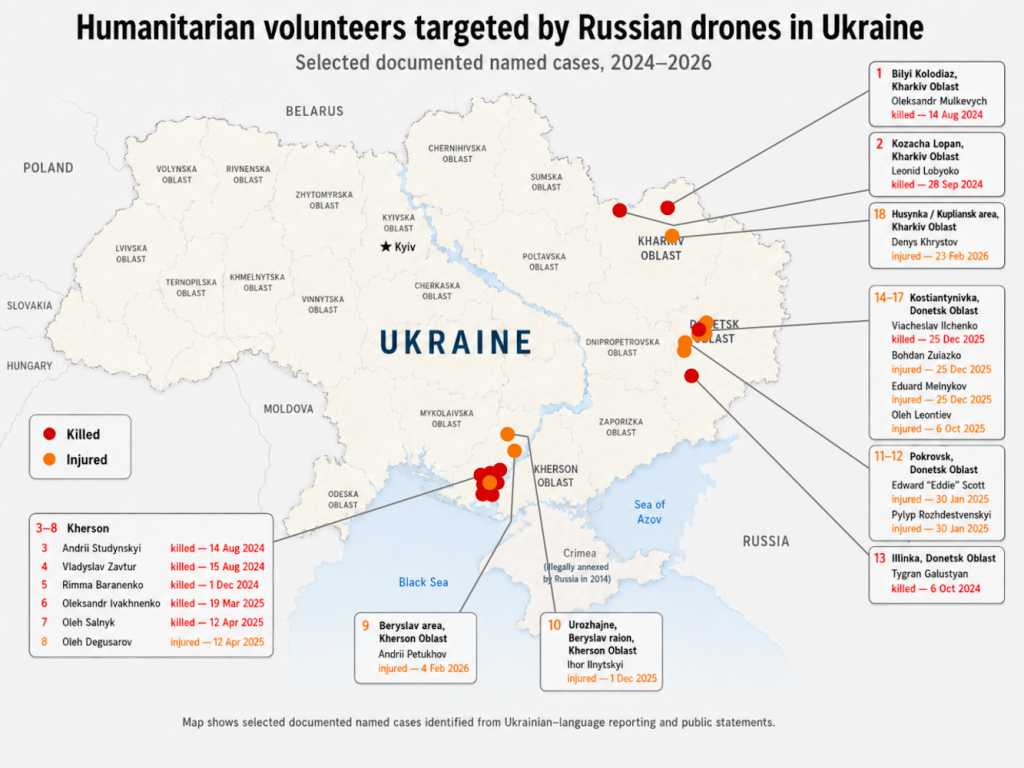
Most attacks concentrated in Kherson, Donetsk and Kharkiv regions. This clearly corresponds to where the humanitarian needs are the greatest.
Effect on humanitarian work: in Ukraine, the 2026 statistics show that most humanitarian workers were killed and injured by drones. This is a very worrying trend that shows how drones are replacing traditional short-range weapons and targeting humanitarians far behind the front.
5. Medics, emergency personnel, small and large NGOs
There are many actors who respond to humanitarian emergencies and save lives in war zones. In Ukraine, we see that small NGOs respond quickly and carry out small projects which are not handled by the international giants.
Examples include providing winter batteries to orphans in foster care, evacuation from the kill-zones in Kherson, delivering medical supplies to frontline hospitals, and more.
The bulk of daily response to attacks on civilians in Kyiv, Sumy, Kharkiv etc. is handled by the Ukrainian state first responders: the ambulance service, the fire brigade and the DSNS emergency responders.
While the large international organisations and state first responders get funding, small NGOs are left behind. Yet their personnel face the same level of danger as everyone else.
Effect on humanitarian work: the role of small NGOs in solving local humanitarian emergencies should be recognised. The risks they face should be respected. Small NGOs should get support for protecting their staff.
Forecast and conclusion
Drone warfare has already dramatically changed the humanitarian working conditions in Ukraine. Drones destroy humanitarian vehicles and ambulances with precision, at distances of up to 30km.
In a few years’ time, it will spread to other conflict areas: in Africa, the Middle East, South-East Asia. The continued technological advancement will make drones cheaper, more lethal and available in larger quantities.
Humanitarian organisations need to prepare for it now. The Geneva Conventions are clearly not observed by Russia (multiple attacks on ambulances). Will they be respected by militia fighters in developing countries when aiming their drones at a humanitarian convoy?
Bright-coloured ambulances and marked humanitarian vehicles attract danger. AI targeting algorithms may learn their bright patterns and target them even more.
The UN, the Red Cross and others need to protect their staff. Since the kill zone is rapidly expanding, not all humanitarian assistance is worth the risk: both for the teams and for the civilian population. Organisations need to triage and decide what missions to undertake.
Providing any humanitarian assistance in war zones will become as risky as military operations. Aid workers will need the same level of protection as soldiers. They will need armoured vehicles, anti-drone jammers (permitted by the local authorities), body armour, secure radios.
Appendix
Humanitarian victims of drone attacks in Ukraine, 2024-2026
| # | Name | Killed / injured | Location | Date | Source |
| 1 | Oleksandra “Mike” Mulkevych | Killed | Bilyi Kolodiaz, Kharkiv Oblast | 14 Aug 2024 | NV reported she was killed by an FPV drone strike on a Hospitallers vehicle. (NV) |
| 2 | Leonid Loboyko | Killed | Kozacha Lopan, Kharkiv Oblast | 28 Sep 2024 | Censor.NET reported he was killed when a drone hit a civilian car while he was delivering humanitarian aid. (Censor.net) |
| 3 | Andrii Studynskyi | Killed | Kherson | 14 Aug 2024 | Suspilne reported he was killed during a drone attack while distributing free water. (Суспільне | Новини) |
| 4 | Vladyslav Zavtur | Killed | Kherson | 15 Aug 2024 | Suspilne reported he died in hospital after being wounded in the same drone attack. (Суспільне | Новини) |
| 5 | Rimma Baranenko | Killed | Kherson | 1 Dec 2024 | Suspilne reported that the local volunteer died after a Russian attack on a bus; other reporting states explosives were dropped from a drone. (Суспільне | Новини) |
| 6 | Tygran Galustyan | Killed | Illinka, Kurakhove community, Donetsk Oblast | 6 Oct 2024 | 24 Kanal and Nakypilo reported he was killed during an evacuation mission when a Russian FPV drone hit the volunteers’ car. (24 Канал) |
| 7 | Edward “Eddie” Scott | Injured | Pokrovsk, Donetsk Oblast | 30 Jan 2025 | Suspilne reported the British volunteer was badly injured by a Russian drone while evacuating civilians; other reporting identifies him as Edward Scott. (Суспільне | Новини) |
| 8 | Pylyp Rozhdestvenskyi | Injured | Pokrovsk, Donetsk Oblast | 30 Jan 2025 | ZMINA and The Blackmore Vale reported that Pylyp received shrapnel wounds in the same drone strike. (ZMINA – Центр прав людини) |
| 9 | Oleh Salnyk | Killed | Kherson | 12 Apr 2025 | Censor.NET reported that Salnyk, a volunteer of the “Spravzhni” foundation, was killed by a Russian drone attack in Kherson. (Censor.net) |
| 10 | Oleh Degusarov | Injured | Kherson | 12 Apr 2025 | Protocol / Bukvy reported that Degusarov, co-founder of “Spravzhni”, was wounded in the same attack that killed Oleh Salnyk. (Protocol) |
| 11 | Oleh Leontiev | Injured | Kostiantynivka, Donetsk Oblast | 6 Oct 2025 | Suspilne reported a drone chased and damaged his evacuation car and that Leontiev was wounded while still evacuating civilians. (Суспільне | Новини) |
| 12 | Devon Masser | Injured | Near Lyman, Donetsk Oblast | 20 Nov 2025 | Suspilne reported an American volunteer was wounded when a Russian drone hit an evacuation vehicle; the New York Post identified him as Devon Masser. (Суспільне | Новини) |
| 13 | Ihor Ilnytskyi | Injured | Urozhayne, Beryslav raion, Kherson Oblast | 1 Dec 2025 | Ukrinform reported the ADRA Ukraine volunteer was seriously wounded by a drone while delivering food aid. (Ukrinform) |
| 14 | Viacheslav Ilchenko | Killed | Kostiantynivka, Donetsk Oblast | 25 Dec 2025 | Kramatorsk Rayon / ZMINA reported he was killed by a Russian FPV drone during an evacuation attempt. (Новини Краматорського району) |
| 15 | Bohdan Zuiakov | Injured | Kostiantynivka, Donetsk Oblast | 25 Dec 2025 | The same report states Zuiakov was wounded in the attack that killed Ilchenko. (Новини Краматорського району) |
| 16 | Eduard Melnykov | Injured | Kostiantynivka, Donetsk Oblast | 25 Dec 2025 | Suspilne reported that Eduard Melnykov was one of the wounded evacuation volunteers. (Суспільне | Новини) |
| 17 | Denys Khrystov | Injured | Husynka / Kupiansk area, Kharkiv Oblast | 23 Feb 2026 | Hromadske reported the volunteer was injured during an evacuation trip in the Kupiansk area. (hromadske) |
| 18 | Andrii Petukhov | Injured / survived drone attack | Kherson / Beryslav area | 2025–2026 | Suspilne and ZMINA documented repeated drone attacks on his evacuation work and the destruction of his evacuation vehicle. |
0 Comments for “Humanitarian Work in the Age of Drone Warfare”